
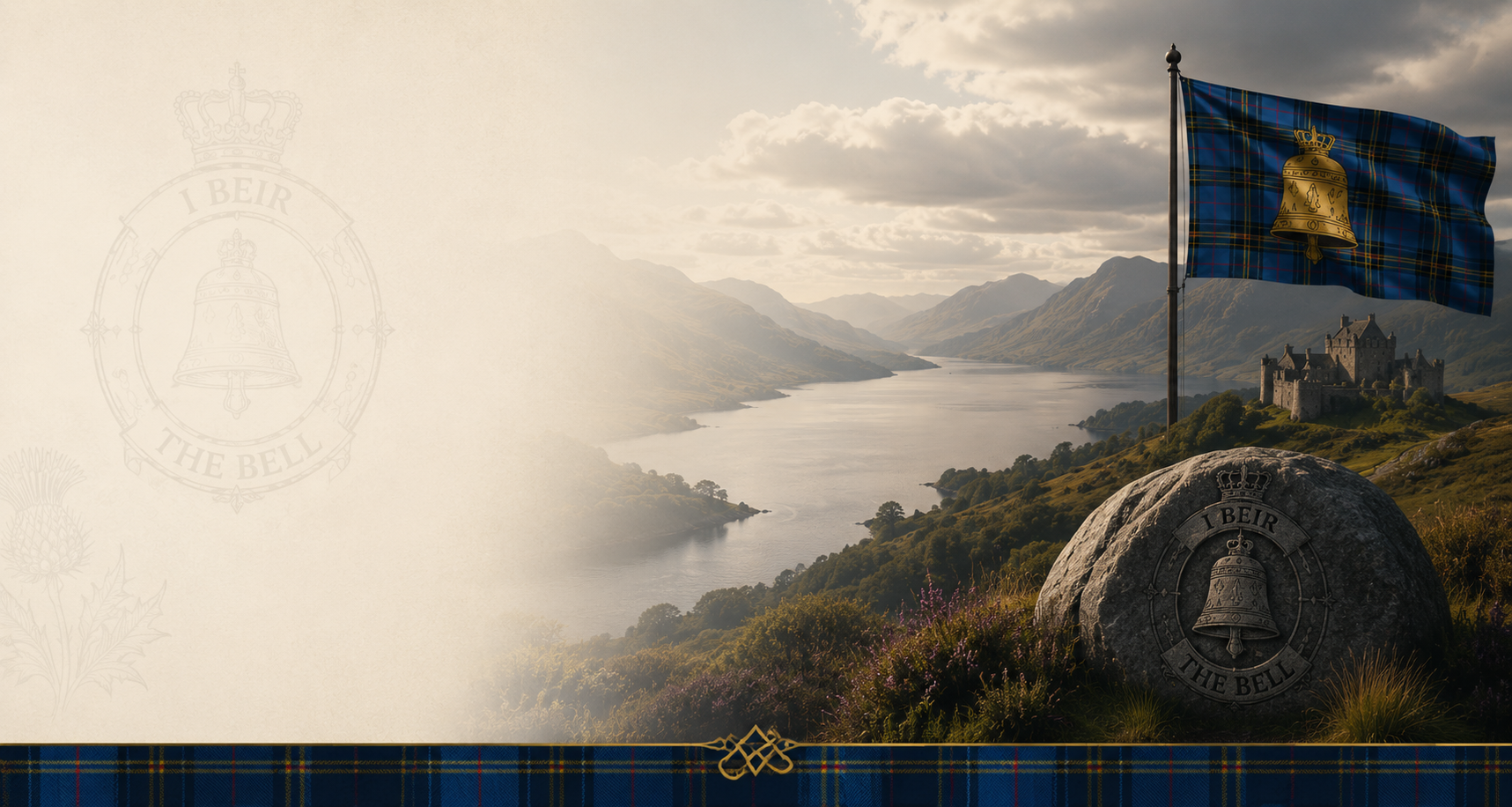
The History of Clan Bell
From the Anglo-Scottish Border to a Worldwide Family
The history of Clan Bell is rooted in one of the most turbulent regions of Britain: the western Anglo-Scottish Border.
For centuries, the Border was neither fully peaceful nor easily governed. Armies crossed it, rival families raided across it, and communities on both sides learned to survive amid warfare, feuding, political uncertainty, and repeated destruction.
The Bells emerged from this difficult landscape as a prominent Border family associated especially with Dumfriesshire, including the country surrounding Middlebie, Kirkconnel, and Blackethouse. Over time, branches of the family spread into England, Ulster, North America, Australia, New Zealand, and elsewhere.
The story of Clan Bell is therefore not simply the story of one place. It is the story of a family shaped by migration, hardship, adaptation, learning, and achievement.
The Origins of the Bell Name
The precise origin of the Bell surname is not settled.
One long-standing tradition holds that the Border Bells descended from a Norman or French follower of David I of Scotland, whose reign from 1124 to 1153 brought many Anglo-Norman families into Scotland. The surname may have developed from the Old French word bel, meaning “fair” or “handsome.”
This is plausible as a surname origin, but it does not establish that everyone named Bell descends from one common ancestor. Bell may have arisen independently in more than one place, and Scottish, English, and Irish Bell families do not necessarily share the same paternal line.
Other proposed explanations connect the name with bells, bell-ringing, or residence near a bell tower. These theories remain possible for individual families, but no single explanation accounts conclusively for every Bell lineage.
The heraldry historically associated with leading Bell families makes use of bells as canting arms—heraldic imagery that creates a visual play on the sound of a name. Such arms refer to the surname as it came to be pronounced, not necessarily to its original linguistic meaning.
A Historical Caution
The Norman-origin tradition is meaningful within Clan Bell history, but surviving medieval evidence does not provide a complete, unbroken genealogy from a named Norman settler to the later Bells of Dumfriesshire. It is best presented as an early clan tradition rather than a conclusively proven family tree.
The Bells Take Root in Dumfriesshire
By the later Middle Ages, people bearing the Bell name were established in southern Scotland.
Among the early figures traditionally associated with the family was Gilbert le Fitzbel, recorded as holding lands in Dumfries during the thirteenth century. Another early Bell, Sir David Bell, served as Clerk of the Wardrobe during the reign of Robert II.
In 1426, the lands of Kirkconnel associated with William Bell were confirmed under a royal charter of James I recorded in the Register of the Great Seal. This places the Bells firmly within the landed society of medieval Dumfriesshire.
Over time, the family became especially numerous around Middlebie. The old expression— “As numerous as the Bells of Middlebie” —reflects the strength of the Bell presence in that part of the Border country.
The leading branch of the family became associated with Blackethouse, near the River Kirtle. From this area, the Bells participated in the political struggles, alliances, raids, and feuds that defined Border life.
The World of the Border Reivers
A Frontier Shaped by War
To understand Clan Bell, it is necessary to understand the Border Reivers.
For several centuries, families living along both sides of the Anglo-Scottish frontier survived amid recurring war between England and Scotland. Military campaigns could leave houses burned, livestock taken, crops destroyed, and communities displaced.
In this environment, loyalty to family often mattered more than loyalty to either crown.
The people later called Border Reivers raided for cattle, horses, sheep, revenge, political advantage, or simple survival. Both Scots and English participated. Raids crossed the formal border in both directions and were also carried out against neighboring families of the same nationality.
The term reiver comes from an old word meaning to rob or raid. These mounted Border families were also known as riding surnames, riding clans, or steel bonnets after the helmets commonly worn by armed riders.
Life on the Border
Border homes were frequently built with destruction in mind. Some poorer dwellings could be reconstructed quickly from stone, timber, turf, or thatch. More prosperous families built defensible stone towers and fortified houses.
Agriculture was risky because stored grain and standing crops could easily be burned or stolen. Livestock could be driven away, but it could also be hidden, recovered, or replaced in a retaliatory raid. Cattle therefore became central to the economy and culture of reiving.
This did not mean that every Border resident was constantly engaged in crime. People farmed, traded, married, worshipped, raised children, and maintained communities. But violence was woven into daily life, and even peaceful families could be drawn into feuds or compelled to defend their kin.
Government authority was divided among the eastern, middle, and western Marches. Wardens, deputies, sheriffs, and local officers were supposed to enforce Border law, but they were often outnumbered, politically compromised, or connected by blood to the very families they were expected to control.
The Bells Among the Riding Families
The Bells became one of the important riding families of the western Border.
They were frequently associated with other powerful surnames, including the Armstrongs, Johnstones, Maxwells, Irvines, Grahams, Elliots, and Scotts. Alliances were rarely permanent. Families that cooperated in one generation might feud in the next.
The Bells are traditionally included among the “Devil’s Dozen,” a phrase used for thirteen of the strongest or most troublesome Border riding families. Lists vary, so the term should be understood as a colorful Border tradition rather than an official organization with a fixed membership.
By the early sixteenth century, the Scottish Crown regarded the Bells as sufficiently troublesome to issue them warnings to keep the peace. In 1517, royal letters reportedly directed members of the family to cease unlawful activity and submit to order.
The Bell stronghold at Blackethouse was attacked during an English incursion in 1547, part of the wider violence then consuming the Border.
Yet the Bells were not merely raiders. They were landholders, soldiers, tenants, local officials, craftsmen, and members of a complex Border society. Reiving is an important part of their history, but it is not the whole of it.
Kinship Across the Border
The political border between England and Scotland did not neatly divide families.
Names such as Bell, Armstrong, Graham, Elliot, and others appeared on both sides. Marriage across the border was common despite official efforts to discourage it. Trade, kinship, shared customs, and local loyalties often mattered more than national identity.
One tradition tells of Scottish and English Bells facing one another during the conflict surrounding the Battle of Solway Moss in 1542 and refusing to fight their own kin. The story captures a genuine feature of Border life: family allegiance could override the commands of distant governments.
However, because versions of this episode are often repeated in later clan histories without a clear contemporary source, it should be presented as a Clan Bell tradition, not as an independently verified battlefield record.
The End of the Reiving Age
The Union of the Crowns
A decisive change came in 1603.
When Elizabeth I of England died, James VI of Scotland inherited the English and Irish crowns as James I. England and Scotland remained legally separate kingdoms, but they now shared one monarch. James sought a more complete union and regarded the old Border as an obstacle to his authority.
The government renamed the region the Middle Shires and began a determined campaign to suppress reiving. Border offices were reorganized, powerful riding families were disarmed, fortified homes were attacked, offenders were executed or imprisoned, and others were forced to leave the region.
The campaign could be ruthless and indiscriminate. Some notorious raiders were punished, but peaceful relatives and dependents could suffer alongside them. By the early seventeenth century, large-scale reiving had become far more dangerous and gradually ceased to be a dominant way of life.
This transformation ended one chapter of Bell history and began another.
William “Redcloak” Bell and the Dormant Chiefship
William Bell of Blackethouse—remembered as William “Redcloak” Bell—is generally regarded within Clan Bell tradition as the last chief of the name.
According to a story preserved in the clan, William defeated a Sinclair knight in battle. The captured knight was eventually ransomed to his family, but Bell retained the knight’s red cloak as a trophy. From that episode, he supposedly acquired the name “Redcloak.”
The story is vivid and important within Clan Bell tradition, although a surviving contemporary record confirming its details has not yet been widely identified.
William is believed to have died around 1628. After his death, no successor achieved continuing recognition as chief, and the chiefship became dormant.
Today, Clan Bell is therefore described as armigerous—a clan without a chief currently recognized by the Lord Lyon King of Arms.
The effort to restore the chiefship is not simply an attempt to revive a title. It is part of a wider effort to document Bell history, connect Bell descendants worldwide, demonstrate an active clan community, and establish an appropriate process through which a commander and, ultimately, a chief might be recognized.
The Bells and the Plantation of Ulster
A New Beginning Across the North Channel
The pacification of the Borders coincided with major settlement projects in Ulster.
Beginning in the early seventeenth century, thousands of people from Scotland and northern England crossed into northern Ireland. Some arrived through privately organized settlements beginning around 1606; the formal Plantation of Ulster followed under royal authority later in the decade.
The official plantation affected six counties—Armagh, Cavan, Donegal, Fermanagh, Londonderry, and Tyrone—while significant privately sponsored settlement also occurred in Antrim and Down. Many settlers came from the Scottish Lowlands, including Dumfries and Galloway, Ayrshire, Lanarkshire, and the Border country.
For the Crown, Ulster offered a means of extending political control and creating Protestant settlements in a region that had resisted English rule. For individual migrants, it offered land, employment, trade, and the possibility of rebuilding lives disrupted by Border pacification.
The Plantation was also profoundly destructive for the native Gaelic Irish population. Land was confiscated, political authority was overturned, and new communities were imposed upon an existing society. Its consequences shaped Irish history for centuries. A responsible account of Bell migration should acknowledge both the opportunities experienced by settlers and the dispossession experienced by native inhabitants.
Bell Families in Ulster
Bell was among the Scottish and northern English surnames established in Ulster during the seventeenth century. Evidence suggests that Bell families became particularly numerous in Fermanagh, while others appeared in Tyrone and neighboring counties.
Not every Ulster Bell necessarily descended from the Bells of Blackethouse or Middlebie. Some may have originated in Scotland, some in northern England, and others may represent unrelated lines sharing the same surname.
Nevertheless, the movement of Border families into Ulster provides an important bridge between Scottish Bell history and the later history of many Scots-Irish or Ulster-Scots Bell families in North America.
The wider migration involved ordinary farmers, tradespeople, soldiers, ministers, craftsmen, and laborers—not merely landowners. Many were seeking greater stability and economic opportunity after generations of Border unrest.
From Ulster to North America and the Wider World
Over succeeding generations, Bell families continued to migrate.
Some remained in Scotland or moved into growing cities such as Edinburgh, Glasgow, and those of northern England. Others established deep roots in Ulster. From there, many descendants joined the eighteenth- and nineteenth-century migrations to the American colonies, Canada, Australia, New Zealand, and other parts of the British world.
These migrations produced Bell families with overlapping but distinct identities:
Scottish Bells rooted directly in the Border country
English Bells with northern Border ancestry
Ulster-Scots Bells descended from seventeenth-century settlers
Irish Bells whose ancestry may follow different lines
Bell families whose exact origin remains uncertain
This complexity is why genealogy, documented family trees, historical records, and DNA research are so important. A shared surname creates a connection, but it does not prove that every Bell descends from a single medieval ancestor.
From Reivers to Scholars, Surgeons, Inventors, and Soldiers
The descendants of Border Bells entered many areas of public life.
Andrew Bell
Born in St Andrews in 1753, Dr. Andrew Bell became known for developing and promoting the Madras system of education, in which more advanced pupils helped instruct others under supervision. His educational work influenced schools in Britain and abroad.
He should not be confused with Andrew Bell, the engraver and co-founder of the Encyclopaedia Britannica. Both men were Scottish and both contributed to learning, but they were separate individuals.
Benjamin Bell and Joseph Bell
Benjamin Bell, associated with the broader Blackethouse family tradition, became one of the important surgeons of the Scottish Enlightenment.
His descendant Dr. Joseph Bell, an Edinburgh surgeon and teacher renowned for careful observation and deduction, taught Arthur Conan Doyle. Doyle later acknowledged Bell as one of the inspirations behind Sherlock Holmes.
George Joseph Bell
George Joseph Bell became a leading scholar of Scots law and Professor of Scots Law at the University of Edinburgh. His writings influenced generations of Scottish lawyers.
General Sir John Bell
General Sir John Bell served with distinction during the Napoleonic era and belonged to the military world shaped by Britain’s wars with revolutionary and imperial France.
Alexander Graham Bell
Born in Edinburgh in 1847, Alexander Graham Bell became one of the central figures in the development and patenting of the telephone. His work in speech, sound, communication, and education made the Bell name internationally famous.
These individuals did not all belong to one demonstrably proven close family branch. They are best presented as notable people bearing the Bell name rather than as members of a single established genealogical line.
The Enduring Character of Clan Bell
The history of Clan Bell cannot be reduced to one image.
The Bells were Border riders, but also farmers and landholders. They lived amid violence, but they also created families, communities, and institutions. They migrated under pressure, yet built new lives across Ulster and the wider world. Their descendants entered medicine, law, education, engineering, military service, business, literature, and public life.
The old Border demanded resilience. That resilience became part of the Bell inheritance.
Today, the descendants of Bell families are scattered across continents, shaped by different nations and traditions. What connects them is not a claim that every Bell shares one perfectly documented bloodline. It is a shared name, a shared historical landscape, and a continuing desire to understand how the many branches of the Bell family fit into a much larger story.
The Border scattered the Bells—but it did not erase them.